Funding Risk
Part Of
Reduced By Practices
- Contracts: Outlines cost structures and helps manage budget expectations.
- Estimating: Accurate estimation helps in securing and managing funding.
- Fundraising: Provides necessary financial resources to support the startup’s operations and growth.
- Outsourcing: Can be cost-effective by leveraging economies of scale.
- Prioritising: Allocates resources efficiently to high-impact areas.
- Release: Delivering features might mean you get paid for the software you write.
- Sales: Generates revenue by converting potential leads into customers.
Attendant To Practices
- Demand Management: Inaccurate demand forecasts can lead to resource misallocation.
- Dependency Adoption: Can incur costs associated with adopting standards or libraries.
- Design: Design can be an expensive bet that doesn't lead to improved software.
- Fundraising: Creates a dependency on investors and their continued support and introduces pressure to meet investor expectations and deliver returns.
- Marketing: Marketing campaigns can be expensive.
- Measurement: Implementing measurement systems can be expensive.
- Monitoring: High-quality monitoring tools and systems can be costly.
- Performance Testing: Performance testing tools and environments can be expensive.
- Prototyping: Creating prototypes can incur additional costs.
- Redundancy: Implementing redundancy can be expensive.
- Sales: Sales activities can incur significant costs.
- Tool Adoption: Can incur costs associated with acquiring and maintaining tools.
Funding risk is the chance that a person or firm won’t be get access to the money it needs when it needs it. This could lead to cash flow problems or trouble paying its bills.
Worked Example
On a lot of software projects you are "handed down" deadlines from above and told to deliver by a certain date or face the consequences. But sometimes you're given a budget instead, which really just adds another layer of abstraction to the Schedule Risk. That is, do I have enough funds to cover the team for as long as I need them?
This grants you some leeway as now you have two variables to play with: the size of the team, and how long you can run it for. The larger the team, the shorter the time you can afford to pay for it.
In startup circles, this "amount of time you can afford it" is called the "Runway": you have to get the product to "take-off" (become profitable) before the runway ends.
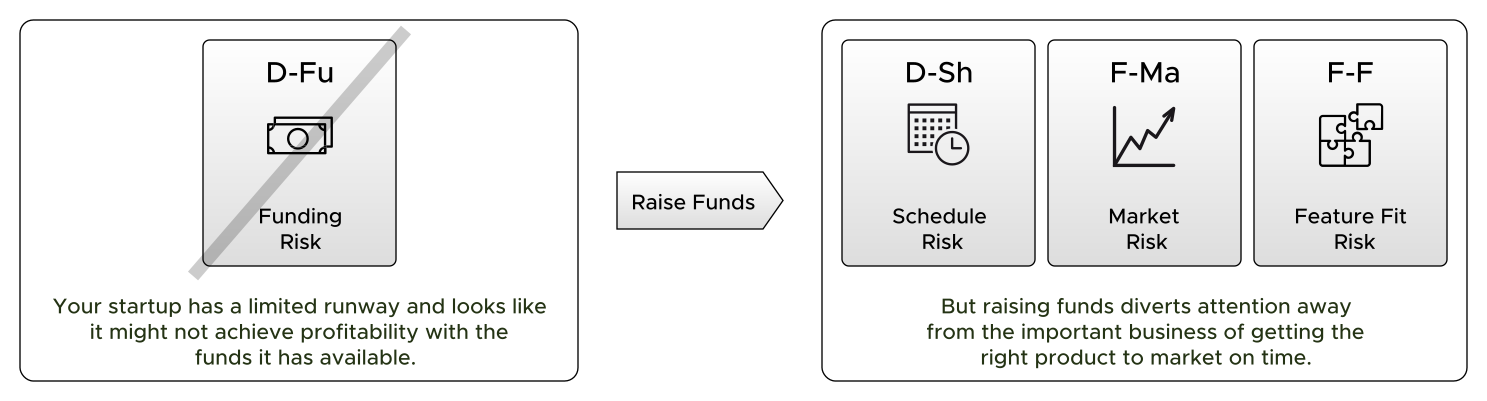
In the above diagram, your startup is constrained in this way and wants to maximise its available runway. Startups often spend a lot of time courting investors in order to get funding and mitigate this type of Funding Risk. The problem with this is that when the founders' focus changes to raising funds, they can no longer be focused on building the right product (i.e. Feature Fit Risk) building it quickly (Schedule Risk) and doing so before the market for the product changes (Market Risk).
Example Threats
1. Threat From the Funder
Threat: The entity supplying the funds changes their mind, creating a funding gap.
Threat: The entity supplying the funds can't afford to continue funding, perhaps due to liquidity issues or bankruptcy.
See Credit Risk
2. Threats From The Capital Markets
Threat: The market changes in some way (perhaps interest rates, a stock crash, exchange rates) which affect the source of funding.
See Market Risk
3. Threats From Demand
Threat: The reason for giving the funding changes - perhaps the sector is less attractive to investors or there is new, stiff competition.
4. Global Issues
Threat: Regulatory, legal or geo-political changes make it impossible for funding to continue.
Boo.com was launched in 1999 as an online fashion brand, hoping to revolutionise the experience of online, interactive shopping. It arrived in a blaze of glory, spending $135 million dollars on marketing - made available to it because at the time the dot-com bubble was in full swing.
Although there were both technology issues and operational problems, the overall approach of the company had been to spend lavishly from their enormous initial funding budget: getting a global fashion brand to market quickly (in order to capture the emerging online fashion sales market) was seen to be the biggest risk.
However, by April of 2000, the dot.com bubble had popped, leaving investors questioning why they had invested so much into boo.com in the first place and refusing to invest further.
On May 18th 2000, boo.com filed for bankruptcy, unable to pay its marketing, wage and technology bills, well before the site was profitable.